

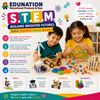
S.T.E.M
, by Team Edunation, 2 min reading time
, by Team Edunation, 2 min reading time
What does S.T.E.M. stand for
S.T.E.M. is an acronym for Science, Technology, Engineering, and Mathematics. It represents an interdisciplinary educational framework and professional approach that integrates these four interconnected disciplines to foster critical thinking, problem-solving, and innovation.
Science: The study of the natural world through observation, curiosity, and experimentation. It covers fields like biology, chemistry, and physics.

Technology: Tools, systems, and digital frameworks that help us work smarter and faster, such as computer science, coding, and robotics.

Engineering: The creative application of math and science to design, build, and troubleshoot machines, structures, and systems.

Mathematics: The language of logic, patterns, and calculations used to measure and model real-world concepts.

Rather than teaching these subjects in isolation, STEM focuses on real-world applications and project-based learning. It equips individuals with essential 21st-century skills such as teamwork, adaptability, and analytical reasoning
Many parents have reported that their children are more engaged and proactive in exploring STEM activities, with increased interest and motivation for learning. STEM learning can help ADHD children learn better and gradually acquire abilities equal to or even superior to those of typical children.
STEM activities combine Science, Technology, Engineering, and Math to solve real-world problems. They range from building quick household contraptions to coding software. These hands-on experiments foster critical thinking and are highly adaptable for all ages.
Popsicle Stick Bridges: Build bridges using craft sticks and glue to explore structural engineering concepts like tension and compression. You can test your bridge's strength by seeing how many pennies it can hold before snapping.
Balloon-Powered Cars: Attach straws and wheels to a small cardboard box or plastic bottle. Tape a blown-up balloon to the back and let it go, using the science of Newton’s third law (action and reaction) to race the car across the floor.
Lemon Batteries: Insert a galvanized nail and a copper penny into opposite sides of a lemon. Connect them with copper wires to an LED bulb to observe chemistry and electrical circuits in action.
Spaghetti Towers: Task students or family members with building the tallest possible free-standing tower using only dry spaghetti noodles and mini marshmallows. This teaches load distribution and iterative design.
Coding a Basic Game: Introduce kids to programming logic by using visual platforms like Scratch to build a simple maze game or interactive animation.