

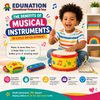
Musical Instruments
, by Team Edunation, 2 min reading time
, by Team Edunation, 2 min reading time
The Benefits of Musical Instruments in Early Child Development
Playing musical instruments is a powerhouse for child development, driving significant growth across multiple areas of a child's life. Extensive research highlights the following benefits:
Cognitive Acceleration: Designed to stimulate and accelerate a student's transition from concrete thinking to higher-order abstract reasoning.
Memory Capacity: Memorizing musical pieces and reading sheet music significantly strengthens your brain's procedural and working memory.
Math & Logic: Reading music requires counting rhythms and recognizing fractional relationships (1 ÷ 2, 1 ÷ 4, etc.), which actively boosts mathematical reasoning.

Language & Literacy: Music acts like a second language. It strengthens auditory processing, word retrieval, and reading comprehension
Motor Skills: It enhances hand-eye coordination, finger independence, and gross coordination, which improves everyday tasks like writing, typing, and athletics.
Hand-Eye Coordination: Translating visual sheet music or audio cues into precise hand movements refines fine motor control and dexterity.
Multitasking: Playing involves processing pitch, rhythm, tempo, and dynamics simultaneously while anticipating future notes

Academic Enhancement: Engaging with instruments acts as a "full-body workout" for the brain, boosting problem-solving skills, expanding working memory, and strengthening pattern recognition essential for math and science.
Emotional Growth: Provides a non-verbal outlet for self-expression, triggering dopamine and endorphin release to regulate mood, and building resilience through the perseverance required to master a skill. It actively enhances emotional intelligence and well-being across all ages.
Stress Management: Music provides a physical and emotional outlet, lowering stress levels and improving your overall mental well-being.
Patience & Discipline: Learning an instrument takes consistent, incremental practice. It trains you to slow down, analyze mistakes, and push through plateaus.
Teamwork & Listening: Playing in a band, choir, or orchestra teaches you how to cooperate, adjust your timing to match others, and contribute to a group without dominating.

Social Skills: By participating in bands, orchestras, or group music classes, individuals build teamwork, active listening, and empathy. Every musician must learn to coordinate their timing, read non-verbal cues, and adjust their volume to create a harmonious sound.

What are the Benefits of Learning an Instrument as a Child?
Memory and Retention. One of the most recognised benefits of learning music at a young age is the benefit it has on memory.
Attention and Concentration.
Speech and Language Skills.
Discipline.
Coordination.