

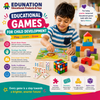
Educational Games
, by Team Edunation, 1 min reading time
, by Team Edunation, 1 min reading time
Why it is Important to Play Educational Games with your kids
Educational games build essential cognitive, social, and motor skills. Activities like jigsaw puzzles, building blocks, and memory-matching challenge children to analyze patterns, strengthen spatial awareness, and enhance memory. Play-based learning can be adapted to specific age groups and learning needs.
Babies and Toddlers (Ages 0–3) Action & Sound Games: Peek-a-boo and "So Big!" encourage eye contact, large motor skills, and emotional connectedness.
Sorting Objects: Putting child-safe toys in and out of a box teaches spatial awareness and vocabulary.

Preschoolers (Ages 3–5) Puzzle & Memory Games: Matching colors, shapes, and sorting items encourage logical thinking and visual memory.
Building Blocks: Open-ended block play builds spatial reasoning, creativity, and hand-eye coordination.

School-Age Children (Ages 6+) Educational Web Games: Use platforms like Education.com to practice math, phonics, and logic through interactive challenges.
Reading & Logic Games: Action-oriented literacy and STEM games
